

Our mailing address:
Molten Aura Labs, LLC
30 Westgate Parkway #310
Asheville, NC 28806
(currently no retail storefront available)
SHOP GLASS
QUICK LINKS
NEWSLETTER
Subscribe to our Newsletter for all the latest news and color release dates!

This page is a small window into our approach here at Molten Aura Labs. We are advancing the state of the art of borosilicate color creation and we’re glad to join you on your journey of advancing the state of your art.
How is Molten Aura Labs glass unique?
The glass colors developed here at The Lab start as crystalline quartz silica. That silica gets combined with high-purity chemicals, then melted into glass at extremely high temperatures. This glass is pulled into rods approximately 6-9mm in diameter and 16-20 inches long. Our goal is to consistently create highly saturated, museum quality borosilicate glass colors.
Every element we use in the glass affects its working characteristics in some way. Having complete control over the composition allows us to minimize undesirable traits while maximizing color saturation and usability. No colored glass is going to work exactly like its transparent clear counterpart. Even different brands of clear boro don’t even behave exactly the same. However, we go to great lengths to ensure that the balance of CTE (Coefficient of Thermal Expansion) and viscosity ensures compatibility with 33CTE Borosilicate.
Why make borosilicate colors from sand?
Before Molten Aura Glass, the industry standard for making colored boro was to purchase pre-made clear glass, grind it into powder, and add varying amounts of colorants. This doped cullet was then re-melted in kilns that typically only reach 2350F. This process had way too many limitations for what we were trying to achieve with colored borosilicate. We wanted stronger colors without sacrificing compatibility and workability. Clear 33CTE borosilicate is essentially 81% Silica, 13% Boron, 4% Alkali, and 2% Alumina. As soon as you add anything to the clear cullet to colorize it, you alter that ratio, changing its workability and it’s CTE. And because there is no way to properly correct for those adjustments using pre-made glass (cullet), you are limited in how saturated the color can be and have no room to improve how it works in the flame.
In addition to enhanced saturation levels, in many cases we are able to improve the working properties, stabilize the compositions, and often completely eliminate air bubbles. Overall, the elements are more fully integrated into the glassy network than a “low-temp”, cullet-based version. This makes for a buttery smooth working experience for the glassblower and a much higher quality finished product.
Our vision is to propel a new generation of borosilicate artwork forward with the richness and optical clarity that has been a staple in soft glass for centuries. We see SANDCRAFTED® glass as the logical next frontier for discerning borosilicate artists and collectors.
Why do your colors require different annealing temperatures than Simax? Does that mean they are not 33CTE?
The coefficient of thermal expansion is only one factor in getting two different materials to seal together. A perfectly matching CTE does not automatically equal “compatibility”. But at the same time, something slightly higher or lower than the specific CTE measurement can still compatibly seal to something else (it doesn’t even have to be glass to glass). So when we refer to 33CTE glass, it is generally understood to represent a family of colored and non-colored borosilicate that is compatible in the area of ~3 × 10⁻⁶ K−1 at 20°C. In fact, “borosilicate” itself is an amazingly broad term that includes a huge spectrum of glasses with a vast range of CTE values, viscosities, opacities, etc., many of which are not at all compatible with Simax.
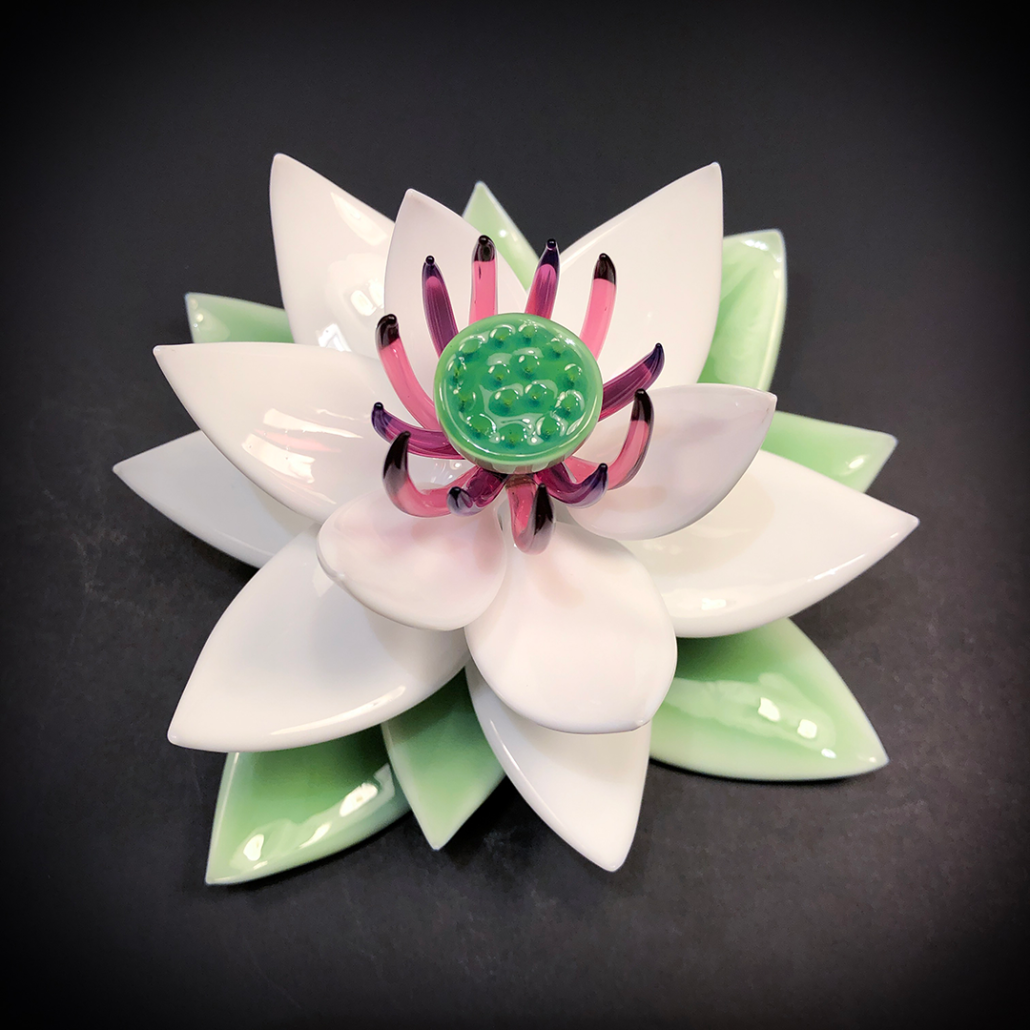
We are not using clear Simax, but starting from sand. As an example, something like Lotus White is obviously a radical departure from clear glass. However, despite it’s unique viscosity curve and CTE measurements, it can still be made to be compatible with Simax. We consider colored glass as unique from clear glass. This is a paradigm shift for most glassblowers, and many manufacturers who typically start with clear cullet and add things to it.
So, viscosity can be different, and CTE can even be different (within reason), and the glass can still be compatible. However, this also means that the annealing/strain temps are different (within reason). “Proper” annealing means there is zero stress left when viewed under a polariscope. “Successful” annealing may mean that your piece stayed together – though there may still be residual stress you haven’t completely relieved.
Ultimately, the glass performing for an individual for their desired effect is what matters most. These balancing acts are not unique to glass making. Metals, ceramics, glasses, plastics, foods, etc. are all formulated as well as they can be within their respective constraints. Anyone exploring the formulation of “different but compatible” materials will quickly learn of the endless variables that need to be accounted for and balanced.
Our SANDCRAFTED® glasses have been extensively tested by artists in various production environments using myriad techniques. Additionally, they have been laboratory tested at Orton Materials Testing and Research Center for exact strain point, annealing point, and CTE (Coefficient of Thermal Expansion). We use these data to help us dial in the formulas, and provide accurate annealing temperature ranges for end users.
What do you consider 1st Quality glass and what are considered Abnormals?
We try to make our glass as clean, consistent, and air-free as possible. There will always be a certain amount of variation in color when producing small batches of glass from scratch. But we do our best to minimize variables and to sell what we consider to be museum quality art materials. For example, 1st quality rods may not always be perfectly round or perfectly 7mm in diameter, and certain colors may have more air than others because of the nature of the materials. Because this is a raw material and ultimately made to be remelted, we focus on the quality of the glass itself above the aesthetic quality of an individual rod.
When the rods are below what we consider to be acceptable as 1st quality, we sell them as Abnormals. Typically this is because of a slight ridge or oblong shape to the rod, or they are thicker or thinner than the 7-9mm range. Or sometimes they are just shorter in length than we’d like. Abnormals are still high quality glass that should be free of stones or other major defects in the glass.
I’ve done a blowout, why does my glass have a streak in it?
We’ve been espousing the practice of making blowouts instead of coilpots for quite a while now, and years ago posted a short demo video on YouTube and Instagram demonstrating a simple technique. We didn’t go into too much detail because there are many ways to create a decent blowout, and just doing blowouts was new to many people at the time. However, there are some things you can do to maximize the quality (and quantity). Some people use more than one rod at a time, some people use benchtop rollers, some people use a lathe, etc. Whichever method you like, we do recommend spinning (rotating) the rod as you are gathering it up. We do this for every glass, no matter the color or manufacturer.
In this photo you can see we took some pretty streaky rods and made them into a perfectly clear blowout using this technique:
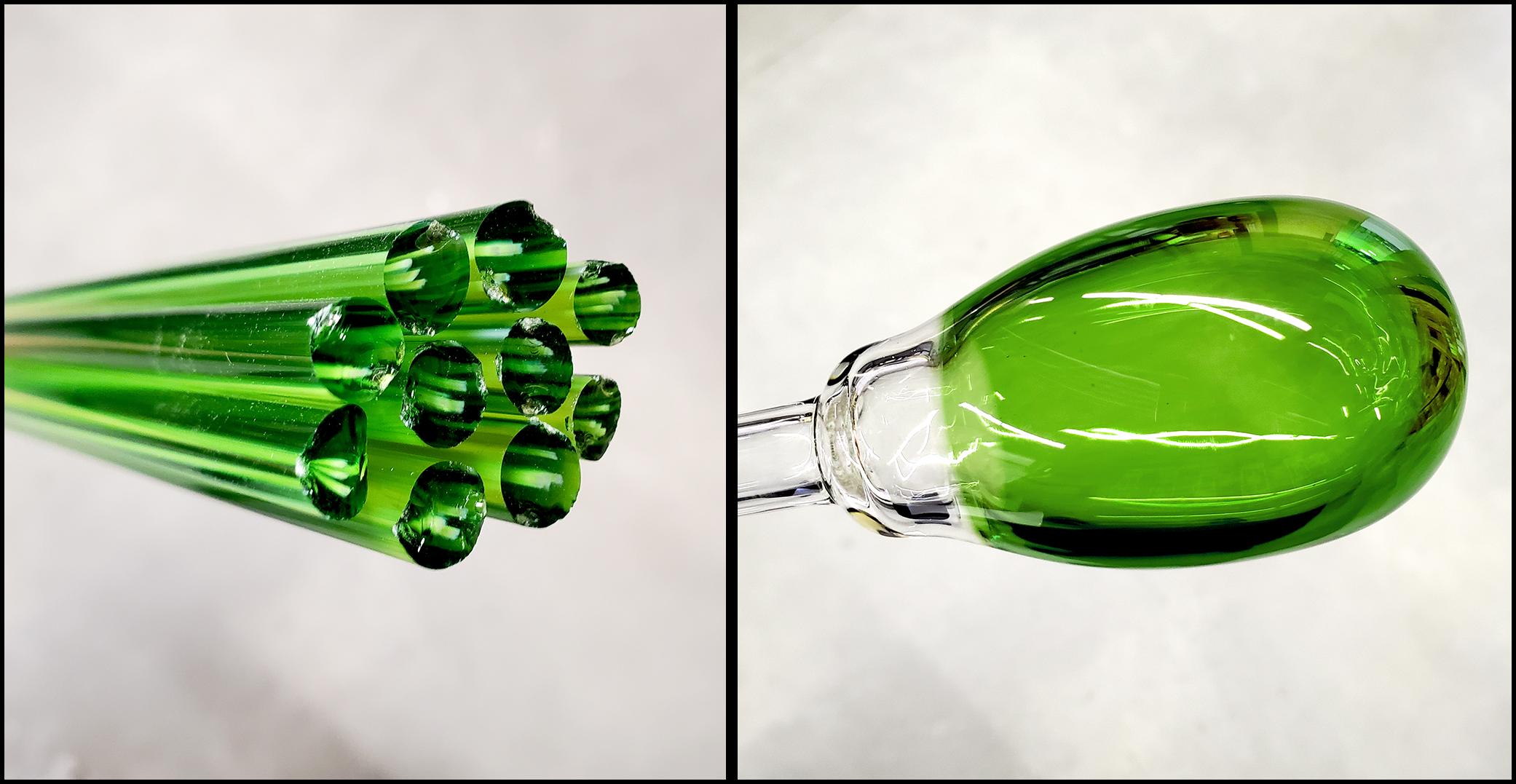
We’ve found that by twirling the rod slightly faster than the punty you are gathering onto, it will help break up and re-mix any immiscible phases formed during rod production and essentially homogenize it. If you spin too fast, you may overdo it and see more streaks and if you don’t spin at all, you won’t get the benefits of this technique. There is an art to this that takes a bit of practice, but in the end it takes no extra time and is worth the attention if you want the clearest glass possible. Borosilicate contains a decent percentage of Boron. As a second glass former in the composition, it has a strong tendency to separate into it’s own phase within the molten glass. This typically exists to some extent whether you can see visible evidence of it or not. Even in the clearest glass you may see a graininess, or a swirl that almost looks like vaseline in the gather or blowout. That is the phase separation being described here. Certain colorants cause this more than others. However, if there is a trace or streak in the glass rod, it does not necessarily mean it is 2nd quality glass. It just needs the proper attention.
Spinning the rod while gathering up the glass blends everything together, reintegrates the phase separation, and also helps to remove any residual stress, or memory in the glass. Be sure to have the glass completely molten and evenly heated throughout. You can think of it like kneading dough, or wedging clay, or even re-mixing oil paint that has separated a bit. These are raw materials that need to be manipulated and prepared properly by the artisan in order to achieve the best possible end product.
If you gather the glass in this way, then make a blowout, the result is optically clear and the glass integrity is “reset”, so to speak. This technique can be applied to solid forms as well. While sometimes you can get away with just gathering up the glass and forming it, you may achieve a clearer result by spinning and gathering the glass, blowing it out, and re-gathering it. These aren’t techniques we invented, but they do produce consistent results.
How are backorders dealt with and how long will it take for my backordered product to arrive?
When you pay for something that is backordered, it means it is not currently in stock but we are actively working on that color. Typically these will ship out in 1-3 weeks, depending on the amount of demand and where you are in the list of orders. Your card will be charged at the time of purchase and you will receive an email when the product ships that will include a tracking number.
If you have more than one item in your cart, we will wait to ship your order until all backordered items in your cart are in stock. If you need something sooner and want to pay the extra shipping, you can contact us at [email protected] to set that up.
Glass that is in stock will typically get shipped within a few business days. Sometimes it may take a week depending on the amount of orders to fill within a release cycle. UPS is usually the cheapest and fastest. But we have USPS available as well for those with PO Boxes or addresses that UPS doesn’t deliver to.
Do you have posters or a color chart?
We do not have a color chart or poster at this time. Our newsletters, the website, and our Instagram page are the best sources for information about our current palette and what is in stock.
Why is nothing in stock? How do I get your colors?
During periods of high demand, our shelves may quickly get depleted. We do our best to keep new and popular colors in stock, but as our palette grows, that is often a challenge. We do our best to balance the production of established colors with resource-intensive R&D.
Why does the latest batch of this color look slightly different than these rods I’ve had in my stash since last year?
Despite our best efforts for consistency, there are going to be variations from batch to batch. It’s the nature of small boutique batches of anything made from scratch (beer, ceramics, glass, wood, textiles, wine, etc.). In our current model, we run several batches in a row of any given color in order to stock up enough for a release. Our best advice is to get as much as you can/more than you need at once to ensure your piece or production run will contain glass with the most consistency possible.
Additionally, we consider these living formulas. We are constantly learning new things and developing new tools and techniques. Over time, we learn ways to make the chemistry of the colors themselves more stable and user-friendly. As such, we often incorporate these new improvements, while doing our best to maintain the hue and saturation as much as possible. If we feel an updated formula has noticeably shifted from the original released color, we would either state very clearly that it has been reformulated, or simply give it a new name, if it is actually that different.
Why does my color look brownish when I use a flash or harsh light?
Several of our colors utilize gold as a colorant, such as Gold Ruby, Gold Amethyst, Royal Jelly, and Telemagenta. Dispersions of discrete gold nanoparticles in transparent media (glass) create the effect. The shape of the particles and the viewing conditions determine the color we see. The brownish haze – or sapphirin – is not a defect, and it has nothing to do with your flame chemistry or kiln cycle. It is a result of direct, reflected light as compared to transmitted light (backlit).
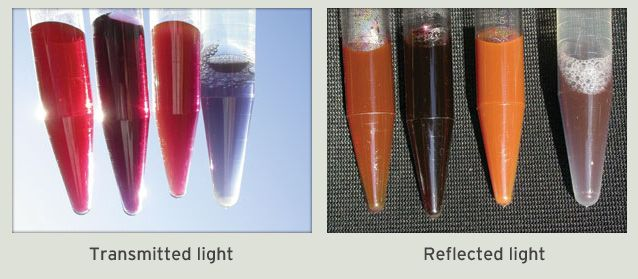
The gold particles in the test tubes on the left are shown in transmitted light, while the image on the right shows the same gold nanoparticles viewed in reflected light.
source: http://www.webexhibits.org/causesofcolor/9.html
What do I do if my piece breaks?
While we may be able to offer some advice or help with troubleshooting in some circumstances, ultimately this is a raw art material and must be treated as such. At Molten Aura Labs, we are dedicated to formulating and manufacturing the highest quality colored borosilicate glass. While we rigorously strive to make our entire line as compatible as possible with the standard 33 CTE (Coefficient of Thermal Expansion) family of glass, the inherent complexities of glassworking mean we can make no absolute guarantees about how our products will perform for you under any and all circumstances.
Compatibility and Performance:
Because every studio environment, technique, and application is unique, no manufacturer can guarantee that glass will perform exactly as expected under all imaginable working conditions. Variations in flame chemistry, striking times, encasement techniques, and combinations with other manufacturers’ colors, opals, powders, frits, or various brands of clear glass can all introduce unpredictable variables.
The Importance of Testing:
We strongly emphasize that testing is a crucial and necessary practice with whatever glass you use. It is the responsibility of the artist to verify compatibility and performance for their specific application before committing to large-scale or high-value projects. We urge all users to employ industry best practices, including:
Running appropriate, fully calibrated annealing cycles for the thickness and complexity of the piece.
Utilizing a polariscope to actively check for structural stress and strain.
Applying the proper tools, techniques, and foundational knowledge of glass chemistry to evaluate compatibility for your intended use.
Please visit our Returns & Shipping page for more legal clarification.

Adam is a fine artist, animator, musician and chemist bridging the gap between design and material science. Following a twenty-year career in video game design and bio-medical visualization, he transitioned into the studio to explore the physical properties of glass.
Adam’s current work focuses on the engineering of permanent coloration in borosilicate glass as well as exploring the development of optical and technical glasses. His unique background—spanning college-level color theory instruction to 3D animation—informs a meticulous approach to both the aesthetics and the technical formulation of his medium.
Aaron began glassblowing in Minneapolis, MN in 2011. He rapidly learned a wide variety of flameworking techniques in the production environment of a shared studio. He also became adept at lathe work and large, clean forms.
Previous to glassblowing, Aaron studied engineering, worked for several years as a luthier building acoustic guitars, and ventured into fine art woodworking. Now he enjoys making and experimenting with new glass colors on a daily basis. Aaron also designs and builds the furnaces, the rod pulling machines, glass tools, and pretty much anything else required for us to push the boundaries of manufacturing colored borosilicate here at The Lab.
Our mailing address:
Molten Aura Labs, LLC
30 Westgate Parkway #310
Asheville, NC 28806
(currently no retail storefront available)
Subscribe to our Newsletter for all the latest news and color release dates!